






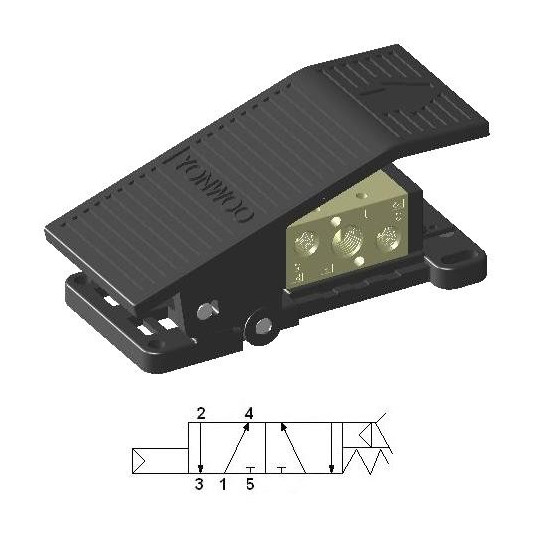
Foot Pedal Pneumatic Valves | Complete Technical Guide
SKU:

In today's industrial environment, operational efficiency and operator safety are fundamental priorities. Foot-operated pneumatic valves represent an ergonomic and practical solution that enables technicians and operators to control pneumatic systems while keeping both hands free for manipulation, assembly, or workpiece holding tasks. This technical guide is designed for professionals in the USA industrial sector seeking to understand in depth the characteristics, applications, and selection criteria of these specialized pneumatic valves.
USA industrial automation, particularly in sectors such as automotive, food processing, packaging, and general manufacturing, demands reliable pneumatic components that optimize production processes. Foot-actuated valves offer immediate and precise response, enabling repetitive work cycles with minimal operator fatigue and maximum productivity.
A foot-operated pneumatic valve, also known as a mechanical foot valve or pneumatic pedal, is a directional control device activated by pressure applied with the operator's foot. Unlike solenoid valves that require electrical signals or pilot-operated pneumatic valves, these valves employ direct mechanical actuation, making them especially suitable for environments where instant manual control is needed without auxiliary electrical systems.
The typical design incorporates a robust pedal connected to an internal mechanism that displaces a spool or piston, thereby changing the flow paths of compressed air. This mechanical principle guarantees rapid and reliable response, even under demanding working conditions. Foot valves are generally manufactured with anodized aluminum bodies or zinc die-cast construction, offering corrosion resistance and extended durability.
The operation of a foot-operated pneumatic valve is based on converting mechanical energy (foot pressure) into movement of internal elements that redirect the flow of compressed air. When the operator presses the pedal, a system of levers or connecting rods transmits the force to the internal spool of the valve, displacing it from its rest position.
Depending on the specific design, this displacement can:
Monostable valves incorporate a return spring that automatically returns the spool to its initial position when the pedal is released, while bistable valves maintain the last position until the pedal is actuated again. This fundamental difference determines their applicability in different industrial processes.
Foot valves are classified primarily according to their configuration of ways (ports) and positions (switching states). The most common configurations in USA industrial applications are:
This configuration is one of the most widely used in simple control applications. It has three ports: pressure (P), work (A), and exhaust (R or E). In rest position, typically the work port is connected to exhaust, while when actuating the pedal, pressure connects with work. They are ideal for controlling single-acting pneumatic cylinders or for start/stop functions in automated sequences.
5/2 valves are the standard for double-acting cylinder control. They have five ports: pressure (P), two work ports (A and B), and two exhausts (R or S). When actuating the pedal, the valve reverses the connections, sending pressure alternately to each cylinder chamber while depressurizing the opposite one. This configuration allows precise bidirectional control and is widely employed in pressing, clamping, and positioning operations.
Less common but equally important, 4/2 valves offer four ports with two positions, while 4/3 valves incorporate an additional center position that can block all ports (closed center), connect all to exhaust (exhaust center), or maintain pressure in work ports (pressure center). These configurations are useful in applications requiring intermediate safety positions or load maintenance.
These valves incorporate an internal spring that automatically returns the spool to its initial position when the pedal is released. They are the preferred option when the system is required to return to a safe or predefined state upon cessation of operator action. Typical applications include safety presses, temporary clamping systems, and operations where continuous pedal control guarantees process activation.
Bistable valves maintain the switched position even after releasing the pedal, requiring a second actuation to return. This design is advantageous in processes where maintaining a position without continuous operator effort is needed, such as in prolonged clamping operations, workpiece positioning at work stations, or control of pneumatic gates.
Foot-operated pneumatic valves offer multiple benefits that make them indispensable in numerous industrial environments:
Foot valves find application in virtually all sectors employing industrial pneumatics:
Proper selection of a foot-operated pneumatic valve requires considering multiple technical and operational parameters to guarantee optimal performance and durability in the specific application.
Industrial foot valves are typically designed for pressure ranges of 2 to 10 bar (29 to 145 psi), with 6 bar (87 psi) being the standard nominal pressure in most USA pneumatic installations. It is essential to verify that the selected valve supports the system's maximum pressure, considering transient peaks. For high-pressure applications (exceeding 10 bar/145 psi), specific models with reinforced bodies and high-resistance seals are required.
The nominal flow rate (expressed in SCFM at standard pressure and temperature) must be sufficient to feed the connected actuator without significant restrictions. The most common port sizes are 1/8", 1/4", and 3/8" NPT threads (standard in USA). For small cylinders, 1/8" ports are usually sufficient, while larger diameter ISO cylinders require 1/4" or larger ports to guarantee adequate cycle speeds.
The flow coefficient (Cv) is a key indicator of the valve's flow performance. Higher values indicate less restriction and faster response times in actuators. For speed-critical applications, such as pick-and-place operations in packaging, selecting valves with optimized Cv is recommended.
The force necessary to actuate the pedal varies according to the mechanical design of the valve and can range between 7 and 22 lbs. For prolonged repetitive operations, selecting valves with reduced actuation force (9-13 lbs) is recommended to minimize operator fatigue. Larger pedals with anti-slip surfaces improve ergonomics and safety, especially in environments where operators wear safety footwear.
Some models incorporate side guards or covers that prevent accidental actuation, a crucial aspect in congested work areas or where multiple operators work in proximity.
The choice between 3/2, 5/2, 4/2, or 4/3 configurations depends directly on the actuator type and required work cycle:
The valve body must be resistant to the operating environment. The most common materials include:
Internal seals (NBR, FKM, EPDM) must be selected according to operating temperature and chemical compatibility with compressed air and possible contaminants. For extreme temperatures or presence of oils, FKM (Viton) seals are recommended.
Foot valves can be mounted directly on the floor via anchors or on elevated structures according to workstation ergonomics. Pedal dimensions and actuation height must allow comfortable operation without forcing postures. Models with wide base and adequate weight offer greater stability, avoiding displacements during repetitive use.
Some designs allow angular adjustment of the pedal or adjustable height, facilitating adaptation to different operators and working conditions.
Proper installation is fundamental to guarantee the performance and durability of the foot valve. The following aspects should be considered:
Compressed air must be adequately treated through an FRL unit (filter, regulator, lubricator) installed upstream of the valve. Filtration eliminates solid particles and condensate that could damage internal seals and sealing surfaces. Regulation ensures constant pressure within the specified range, while lubrication (if the valve design requires it) maintains moving parts in optimal condition.
For valves that do not require lubrication (self-lubricated designs), it is important to verify that lubricator oil does not reach the valve, as it could degrade seals designed for dry operation.
Use quality pneumatic fittings appropriate to the tube type employed. For permanent installations, brass fittings offer maximum reliability, while for flexible installations, push-in fittings facilitate quick assembly and maintenance.
It is crucial to correctly identify each port according to standard nomenclature:
Apply appropriate thread sealant (PTFE tape or non-hardening liquid compound) avoiding penetration into the valve interior. Tighten connections to the torque specified by the manufacturer, typically between 7 and 11 ft-lbs for 1/4" threads.
Fasten the pedal base to the floor or structure using appropriate bolts. On smooth surfaces, bases with anti-slip surface or rubber mats can be used to prevent displacement. The location should allow comfortable actuation without interfering with other work areas or personnel circulation.
Before connecting the actuator, verify valve operation by actuating the pedal and checking that air flows through the correct ports in each position. Gradually adjust system pressure to the operating value, verifying absence of leaks in all connections. Perform several test cycles without load before connecting the final actuator.
Although foot valves are low-maintenance components, certain practices significantly extend their service life:
Review monthly the pedal condition, looking for signs of wear, cracks, or deformations. Verify that the return mechanism (in monostable valves) functions correctly and that there is no excessive play. Inspect pneumatic connections for leaks, which can be detected by applying soapy water or specific leak detectors.
Keep the valve and pedal free from dust, metal chips, and other contaminants that could infiltrate internal mechanisms. In especially dirty environments, consider using protective covers or bellows that isolate moving parts.
Internal leaks manifest as loss of force in the actuator or unwanted movements. External leaks generate characteristic noise and waste compressed air, increasing energy costs. Both situations require immediate inspection and, if necessary, seal replacement or complete valve substitution.
Seals and gaskets are wear components that eventually require replacement. Frequency depends on usage intensity, compressed air quality, and environmental conditions. Maintaining a stock of seal kits for critical models reduces unplanned downtime.
| Symptom | Probable Cause | Solution |
|---|---|---|
| Pedal does not return to initial position | Damaged return spring or blocked mechanism | Inspect internal mechanism, clean or replace spring |
| Air leak through exhaust at rest | Worn spool seals | Replace seal kit or complete valve |
| Slow actuator response | Restriction in ports, insufficient flow | Verify tube and fitting diameter, consider higher flow valve |
| Actuation requires excessive force | Internal friction, lack of lubrication | Lubricate mechanism per specifications, verify absence of contaminants |
| Excessive exhaust noise | Absence of mufflers | Install mufflers on exhaust ports |
The USA automotive industry, with major production centers in Michigan, Ohio, Kentucky, and Tennessee, extensively employs foot valves on assembly lines. Typical applications include control of component insertion presses, body clamping devices during welding, and positioning systems at interior assembly stations. The ability to keep both hands free while controlling the pneumatic cycle is especially valued in operations requiring simultaneous manipulation of multiple parts.
In food and beverage processing plants, where hygiene and absence of electrical contamination are priorities, stainless steel foot valves are the preferred solution. They are employed in control of dosing gates, filling systems, product forming presses, and package sealing devices. Ease of cleaning and construction free from residue accumulation zones are requirements met by specialized designs for this sector.
Consumer product packaging lines use foot valves for activation of heat sealers, cutters, labeling systems, and grouping devices. Manual synchronization via pedal allows the operator to adjust the cycle according to specific characteristics of each batch, maintaining production flexibility without need for reprogramming automated systems.
Woodworking shops and furniture factories employ foot valves to control gluing presses, workpiece clamping systems during machining, and positioning devices in assembly operations. The robustness of these components makes them ideal for environments with wood dust and chips present.
In industrial maintenance and vehicle repair shops, foot valves control pneumatic impact wrenches, hydraulic presses with pneumatic actuation, and lifting devices. Pedal control allows the technician to keep both hands on the part or tool, improving safety and precision.
One of the most frequent errors is selecting a 3/2 valve to control a double-acting cylinder, or vice versa. This results in incorrect operation, unpredictable movements, or inability to complete the cycle. The solution is to always verify the actuator type before specifying the valve: single-acting cylinders require 3/2 valves, while double-acting cylinders need 5/2 valves or equivalent configurations.
Selecting valves with ports too small or insufficient flow coefficient generates slow cycle times, erratic actuator movements, and productivity loss. This problem is especially critical in high-speed applications such as pick-and-place or rapid pressing operations. The solution involves calculating required flow based on cylinder chamber volume and desired speed, selecting valves and pneumatic hoses with adequate capacity.
Feeding foot valves with unfiltered air or excessive humidity is a common cause of premature failures. Solid particles wear seals and sealing surfaces, while condensed water corrodes internal metal components. Installation of appropriate filters and dryers is essential to guarantee extended service life.
Foot valves installed without adequate fastening tend to displace during use, generating discomfort for the operator and potential risk of tube disconnection. Always secure the base with bolts or use models with sufficient weight and anti-slip surface for temporary installations.
Compressed air exhaust generates noise levels that can exceed legal occupational exposure limits (90 dBA for 8 hours according to OSHA regulations). Not installing mufflers on exhaust ports is an error that affects operator hearing health and can generate penalties for regulatory non-compliance. Sintered bronze or polyethylene mufflers are economical and effective solutions.
Combining NPT (National Pipe Thread) with BSP (British Standard Pipe) generates leaks and connection damage. In the USA, the standard is NPT tapered threads. Always verify compatibility before making connections and use certified adapters if mixing standards is necessary.
Foot-operated pneumatic valves represent an ergonomic, reliable, and economical solution for controlling pneumatic systems in countless industrial applications. Their ability to free both operator hands while maintaining precise control of the pneumatic cycle makes them essential components on assembly lines, manual work stations, and maintenance operations.
Proper technical selection, considering parameters such as way configuration, working pressure, required flow, and environmental conditions, guarantees optimal performance and extended durability. Correct installation with adequately treated compressed air through air treatment systems and basic preventive maintenance are determining factors to maximize return on investment.
At Pneumatig, we understand the specific demands of USA industry and offer a wide range of foot-operated pneumatic valves from recognized manufacturers, backed by specialized technical advisory and immediate availability from our warehouse. Our engineering team can assist you in selecting the optimal model for your specific application, considering not only technical parameters but also ergonomic, safety, and integration aspects with your existing systems.
The combination of quality components, professional installation, and adequate maintenance guarantees efficient, safe, and productive pneumatic systems that directly contribute to your industrial operation's competitiveness. Whether you are designing a new production line, modernizing existing equipment, or seeking to solve operational problems, properly specified foot valves are an investment that translates into improved productivity, reduced cycle times, and greater operator satisfaction.
For specific technical inquiries about selecting foot-operated pneumatic valves for your application, or to request information about availability and detailed specifications of our models, our technical team is at your disposal to provide personalized advisory that ensures the optimal solution for your industrial needs.
We use cookies Cookie settings
Pneumatig and our partners (Google, OpenAI) use cookies and similar technologies to keep the shop reliable and secure, to measure visits and the effectiveness of our ads, and to show you offers and ads tailored to you. "Accept all" means you consent to all these purposes, including sharing data with our advertising partners, who may also process it outside the EEA (e.g. in the USA). "Only necessary" means we use only the cookies the shop needs to work. "Set preferences" lets you choose the purposes yourself. You can change or withdraw your consent at any time via "Cookie settings" in the footer. Choose which cookies we may use. You can change your choice at any time – withdrawing consent is as easy as giving it. Cookie policy
Required for the shop to work: cart, login, security and remembering your cookie choice. Always active. Services: Pneumatig (shop), Google reCAPTCHA
Additional features and remembering your settings. Services: Google Tag Manager (consent signal functionality_storage)
Personalising content and making the shop easier to use. Services: Google Tag Manager (consent signal personalization_storage)
Visit statistics that help us improve the shop. Services: Google Analytics 4, Google Tag Manager
Measuring the effectiveness of our ads and showing ads tailored to you. Services: Google Ads, OpenAI Ads (ChatGPT ads measurement pixel)
Full cookie policy · Privacy policy
Login and Registration Form
Forgot your password?
Enter the e-mail address of your account. We’ll send you a link to set a new password.
Back to sign in